Chapter 3 The Seasons of the Gardens

Central Experimental Farm

From Winter to Spring

Portrait of Isabella Preston drawn inside an orange-toned sculpted medallion.

Winter’s cold puts a pause on blooming, but it’s the perfect time to prepare your garden. I use this time to plan my experiments and decide where I’ll plant things once the warmth returns.

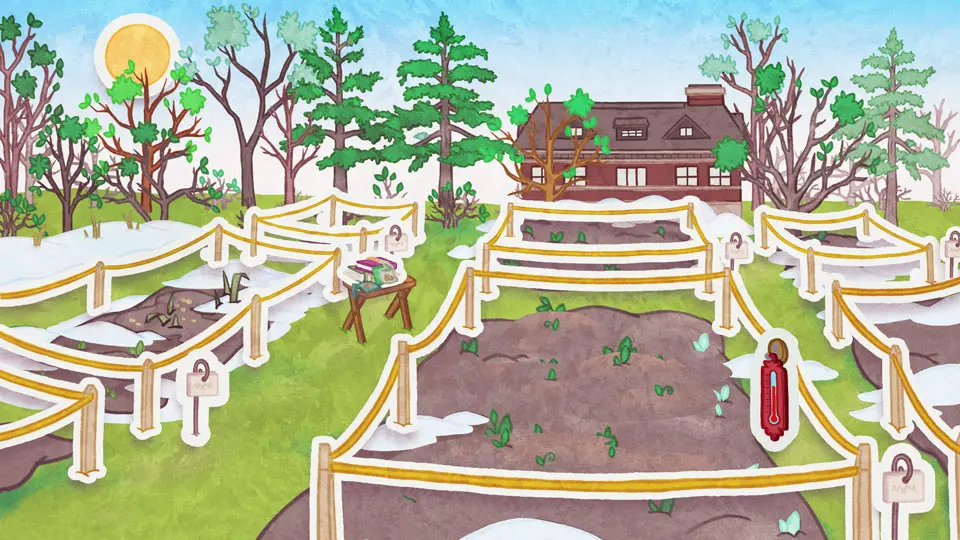
Place in the garden the elements that signal the transition from winter to spring.

 

Drawing of the Ornamental Gardens at the Central Experimental Farm during winter. Heavy snow covers all the flower beds and pathways. The brown house is clear of snow, and a few coniferous trees in the background add a touch of greenery. The nearby trees are bare.Drawing of the Ornamental Gardens at the Central Experimental Farm in spring. In the background, the brown house is beginning to disappear behind leafy trees. In the foreground, the gardens are outlined with ropes and stakes, the sun is melting the snow, and new sprouts are emerging.
The different elements that were optional for the garden’s evolution. Two of them hinder it.

Tags help me locate my plants. They’re essential for my experiments.

The tools allow me to organize my gardening space well.

Consulting books helps me prepare my experiments and plan my gardens effectively.

The warmth melts the snow, revealing the soil underneath.

When the cold lasts too long, it delays seed planting.

Moles damage plant bulbs and roots.

  • Thermometer: Warm : useful
  • Stakes and ropes : useful
  • Books and plant press : useful
  • Identification tag : useful
  • Sun : useful
  • Snowflake : harmful
  • Mole : harmful

After winter comes spring

Here in Ottawa, winters are cold and snowfall can be heavy at times. It’s not uncommon for temperatures in the garden to drop below 5 degrees Celsius, which affects how I organize and plan my experiments.

Winter at the Arboretum
In this photograph of the Arboretum, the trees are buried under snow and the paths are completely covered.

With the arrival of spring, the snow slowly melts and the temperatures begin to rise. It’s the perfect time to start seedlings indoors to help them bloom more easily once they’re in the garden.

Tropical Greenhouse
Here, a building with a glass-vaulted roof stands at the centre of the photograph. The building’s white door is framed by green shrubs. Through the glass, various green plants of different sizes can be seen. In the foreground, leafy tree branches partially intersect the photograph.

As the snow melts, the soil and pathways become clear: I can begin organizing my garden beds. I plan out the space, mark the garden boundaries, and identify planting zones. Thanks to these marking and identification methods, I can quickly locate my plants as they grow. All of this is essential for scientific observation!

The return of warmer weather and the start of field experiments bring the garden back to life. It feels great to be working out there again!

Volunteers from the Friends of the Central Experimental Farm at work in the perennial beds, June 2014.
A grassy path divides the photograph. About ten people are working in flower beds filled with a variety of colours. Red and pink flowers occupy the foreground; behind them are white and yellow blooms. In the background, a row of green shrubs and leafy trees marks the edge of the garden. A wheelbarrow and several buckets of soil are scattered throughout the garden.

Hello!

The standard version is more interactive and immersive but may present some accessibility barriers. The alternative version is the opposite: less interactive, less immersive, and less likely to pose accessibility challenges.